- cross-posted to:
- programmerhumor@lemmy.ml
- cross-posted to:
- programmerhumor@lemmy.ml
You must log in or register to comment.
This symbol isn’t needed for spells this long, but it’s considered best practice and other wizards will make fun of me for not including it, even though it isn’t needed.
mood
“Oh, dude, you gotta stop using TJ’s Action Rune of Changed Files. That runebook has a backdoor to one of the hells now. Didn’t you see the patch notes?”
I never update my spell book and nothing bad has ever happened.
Help. Infernal imps somehow got inside my sanctum and used my scrying orb to send rude messages to the rest of the Circle.
You got lucky. Somebody snuck a wyrm into my codex that got all of my thralls mining for coin bits.
whats that? i use yenjis discus checker scroll, i know it was abandoned long ago back in the old days of the spell assemblers (when they were still a thing) but IT. JUST. WORKS. i dont need those fancy new features, i just want to see if the runes and incantations written on my magic discus got corrupt or not.
shout out to the trickster mod which is basically “what if magic is a lisp”
My brother in Christ, why must you inform us of cool things and leave us with less free time? 🫠
malice
How does it compare to hex Casting? I Tried getting into it but it seemed a Bit weird
hex casting is stack-based and has lots of different blocks for doing different things. trickster is fully functional and has very few blocks, but isn’t as well balanced for use with other mods. at least i think that’s the case.
So does that mean trickster is easier to get into?
Interesting. Does this provide any game balance whatsoever?
I spent an embarrassing amount of time trying to design magic systems when I was a teenager, but they always ended up being either way too powerful or not “rich” enough to be interesting. It’s just really hard to design a simple mechanical system that stays within arbitrary human boundaries.
Hmm, I feel myself getting drawn back in. That’s almost like a zero-knowledge proof, and there’s lots of weird ways to implement cryptographic primitives.
no, it does not. there is a rune that consumes amethyst but it’s just for flavour, so you can give your spell a cost if you want.
i guess you could say the learning curve is a balance feature. it’s an entire functional programming language in a pretty unergonomic form factor, so actually building spells that do anything impressive takes a lot of time.
Only until you’ve figured it out, at which point you’re god. You could make it non-repeatable somehow to avoid that, but magic is depicted as being mainly old, repeated spells most of the time, like in the comic. You could also move to something like Brainfuck or even Malbolge where coding a single new program is hard. As I learned the hard way, though, you’re still going to have no control over what ends up being easy and what’s not.
Actually, it’s more like homeomorphic encryption since you have a system of some bounded complexity instead of a single fixed piece of information. That’s usually harder, but then again you actually want the scheme to be “insecure” in this case.
Yeah that mod is really cool. The magic writing system is fucking awesome.
Even cooler than Hex Casting in my opinion (which is already super cool).
And It’s quite a bit easier to work with since it’s not stack-based and that you can edit different parts of you spell/program at any point.
Whats the issue with Stack based?
When I worked with a stack Hex Casting’s stacks, it was hard to go back and edit previous parts of the program that are stored deeper in the stack. A lot of it has also to do with Hex Casting’s writing design maybe, everything is evaluated more immediately from what I remember.
The other thing is that Trickster’s programs are tree/graph based, which makes the layout of the programs a lot easier to understand logically.
Who is the artist?
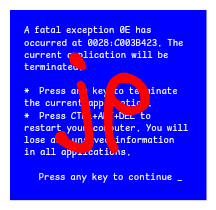
tries to hide C:\jp\scripts\whuj9f.bat and the fact he copied 90% of the thing from a post in the offtopic section of a gaming forum behind his back (with no success)
oh also hhe62m.lsp was copied off a magic spellbook dont ask about it
Syntax error: Mismatched △
FATAL ERROR! DRAIN ARCANE ENTRY IMMEDIATELY!
ARCANE ENERGY COULD NOT BE DRAINED AND WILL BE DISPERSED WHEN PROCESS IS TERMINATED.
Kernel panic: Syntax error in interpreted kernel code. Spell OS 0.2.437 will now terminate.*Firery explosion
“And that’s the most efficient way we’ve found of casting fireball. We’re still working on getting round to finding a more elegant solution.”
“Thank you for playing Wing Commander”
If you’re adding code you don’t understand to a production system you should be fired
Edit: I assumed it was obvious from context that I’m referring to copy-pasting code from stack overflow or an LLM or whatever without knowing what it does but apparently that needs to be said explicitly.
Many times the code we work on is built in abstractions we don’t know about from top to bottom.
Man this is just another great example of why I think software is essentially magic.
At the root of it, the hardware, it’s magic smoke. It’s all based on magic from that point up - because the layer below the one you are using “works because it does.”
I think it depends a lot on a person’s individual knowledge. If you keep studying far enough away from your main area of expertise, there’ll still be some point where you stop and have to blindly accept that something “just works”, but it will no longer feel like that’s what your main field is based upon.
Imagine a chef. You can be an OK chef just by memorizing facts and getting a “feel” for how recipes work. Many chefs study chemistry to better understand how various cooking/baking processes work. A few might even get into the physics underlying the chemical reactions just to satisfy curiosity. But you don’t need to keep going into subatomic particles to have lost the feeling that cooking is based on mysterious unknowns.
For my personal interest, I’ve learned about compilers, machine code, microcode and CPU design, down to transistor-based logic. Most of this isn’t directly applicable to modern programming, and my knowledge still ends at a certain point, but programming itself no longer feels like it’s built on a mystery.
I don’t recommend that every programmer go to this extreme, but we don’t have to feel that our work is based on “magic smoke” if we really don’t want to.
ADDED: If anyone’s curious, I highly recommend Ben Eater’s YouTube videos about “Building an 8-bit breadboard computer!” It’s a playlist/course that covers pretty much everything starting from an overview of oscillators and logic gates, and ending with a simple but functional computer, including a CPU core built out of discrete components. He uses a lot of ICs, but he usually explains what circuits they contain, in isolation, before he adds them to the CPU. He does a great job of covering the important points, and tying them together well.