

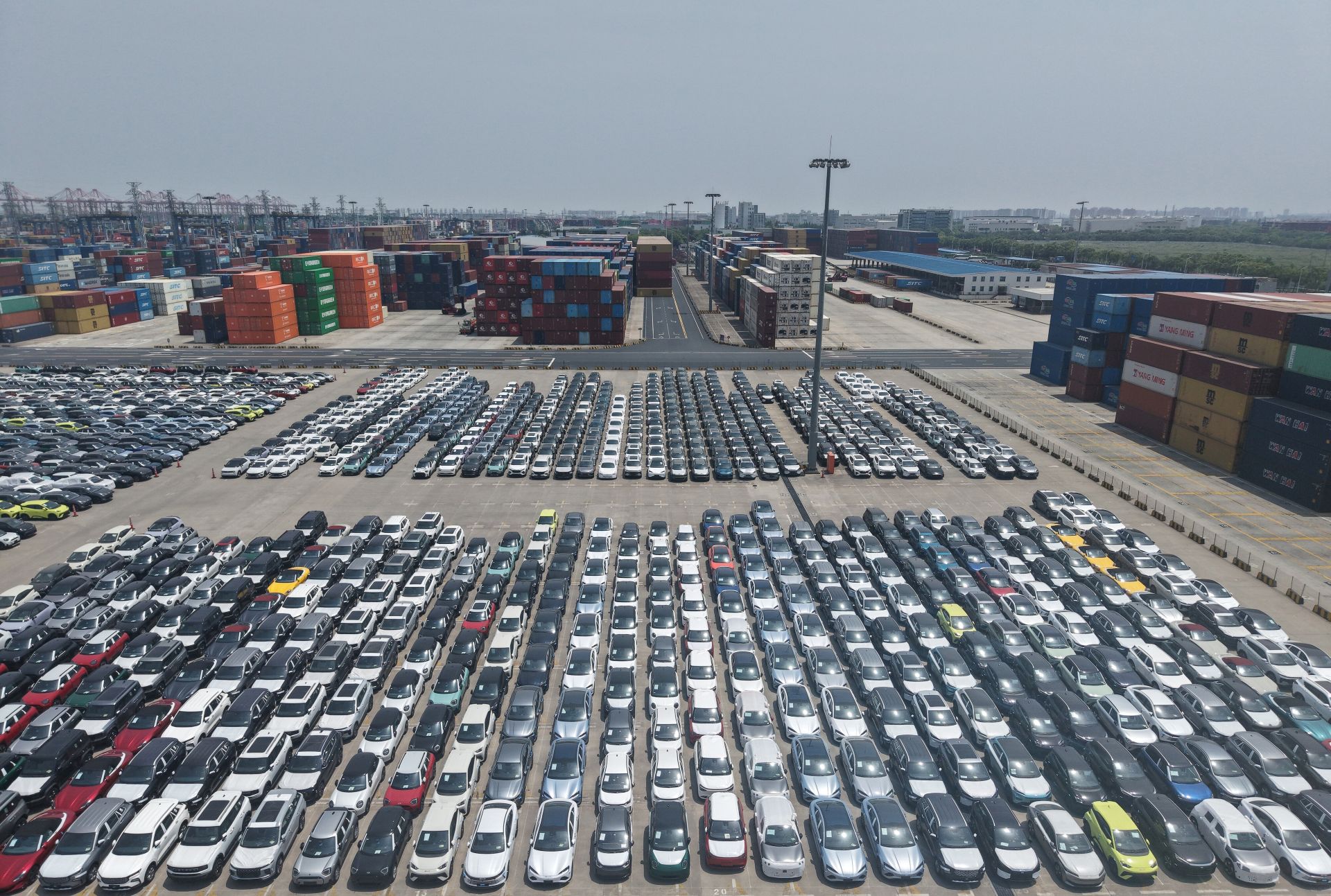
Following Prime Minister Mark Carney’s announcement in Beijing that Canada will allow a limited annual quota of Chinese electric vehicles (EV) into the domestic market at reduced tariffs, the federal government has framed the agreement as a pragmatic response to rising vehicle costs and slowing EV adoption in Canada.
…
While the agreement may ease immediate price pressures, it introduces longer-term risks that deserve closer scrutiny. In particular, it raises questions about Canada’s industrial resilience, environmental accountability and strategic autonomy at a time of growing global economic fragmentation.
…
There is little dispute that affordability has become a binding constraint on EV adoption in Canada. Recent policy shifts, including the removal of consumer incentives and a pause on the EV availability standard, a regulation intended to require automakers to ensure a minimum supply of electric vehicles in the Canadian market, have coincided with a measurable slowdown in EV uptake.
Allowing a quota of lower-cost imports could help temporarily bridge this gap. In that sense, the agreement responds to a real political and economic challenge. However, the concern is not whether prices fall in the near term, but whether trade policy aimed primarily at correcting short-term market failures creates structural vulnerabilities if it is not paired with a broader industrial strategy.
…
Chinese EV manufacturers operate within a political economy that differs fundamentally from that of Canada and most OECD countries. Their cost competitiveness reflects not only technological efficiency, but also extensive state support, preferential financing, controlled energy prices, and regulatory frameworks that do not fully internalize environmental and labour costs.
Allowing a limited number of these vehicles into the Canadian market falls short of neutral competition in the conventional sense. It introduces a degree of dependence on an external industrial system over which Canada has limited regulatory influence and little leverage in the event of trade disruption or geopolitical tension.
…
Lower vehicle prices are often presented as an unequivocal benefit to consumers. Industrial economics suggests a more complex reality. Sustained exposure to heavily subsidized imports compresses margins for domestic manufacturers and suppliers, discourages investment, and erodes production capacity over time.
This dynamic can reduce competition rather than enhance it, leaving consumers more vulnerable to supply concentration and price volatility in the future. Similar patterns have been observed in sectors such as solar manufacturing and consumer electronics, where early affordability gains were followed by industrial hollowing out.
From a policy perspective, the relevant question is not whether prices fall over the next year or two, but whether Canada retains the capacity to participate meaningfully in the value chains that underpin its transportation system.
…
Reliance on external suppliers for critical transportation technologies may reduce costs in the short term, but it also constrains future policy options. Once domestic capacity erodes, rebuilding it becomes costly and politically difficult. Strategic exposure accumulates gradually and is often recognized only after options have narrowed.
From this perspective, the EV quota agreement should be evaluated not only in terms of consumer prices and adoption rates, but also in terms of its implications for Canada’s long-term autonomy in mobility and manufacturing.
…
Alternative approaches exist. These include conditional imports tied to Canadian job creation, local manufacturing, or supply chain participation, binding technology transfer requirements, stronger recycling and materials recovery mandates, and a greater emphasis on smaller, less mineral-intensive vehicles. These measures are more complex to design, but they better align affordability goals with long-term capacity building.
…
In an era defined by uncertainty, durable policy frameworks matter more than quick fixes. The challenge for Canada is not simply to accelerate the EV transition, but to ensure that the transition strengthens rather than weakens the foundations on which it depends.
Similarly, you have your life and are free to stick to whatever propaganda channels you want to believe in.
The “us” in the statement refers to voters, such as myself, who recognize both governments (China and Canada in this case) subsidize industries and the fact that other developing countries have complained about Western subsidies dismantling their nascent industries. There are a lot of good analyses. Feel free to read them to broaden your horizons (there are some good reports also here on Lemmy as I have seen) and then come back.
It’s apparent that you don’t even have the willingness to engage in good faith discussions. When you are on the winning side you claim “International Rules-Based Order”. At the moment the environment changes you claim to be the ‘first’ to “stop putting the sign on the window”, as the PM said, and acknowledge it was never true to begin with.
Yeah, and myself, too? And those other voters with a opinion different from yours?
It’s a safe bet that you and your like minded ‘comrades’ don’t represent the voters.
Safe bet, eh? Where’s my money now?
source: https://www.ipsos.com/en-ca/slim-majority-canadians-54-support-stronger-trade-ties-china
The same poll says that Canadians prioritize human rights and economic opportunities in new trade deals. How did Mr. Carney pursued that?
That aside, it’s just a poll that gave participants a binary choice. If you ask Canadians about their most important economic partners, they paint a different picture: They prefer the European Union (43%), then the UK (40%), Mexico (33%), and only then comes China (27%).
Wow you made an entire set of posts to spread propaganda. Lol what a looser.
Moving the goalposts, aren’t we?
The question of this thread is increasing trade with China. It is a binary question. Yes or No.
From Abacus:
The abacus poll was conducted a year ago, while the Ipsos poll is this year. My how a year changed things.
The abacus poll also asks about international partners not economic partners. International partners include a partner in diplomacy as well as trade.
The abacus poll does not ask strictly about increasing trade.
You are still lying by changing the presented facts.
Do fucking better.
Again, where’s my money? I can DM you my Interac information.
Always moving the goalposts. Never good faith engagement. Had the gall to claim isn’t here to win an argument. 😆
They’re even using the misinterpreted poll as a stand alone post to spread propaganda see:
https://vger.to/scribe.disroot.org/post/6923350
Wait what. I assumed they’re showing other resutls from the same poll from December. I did not suspect it’s a poll from March! Wow the dishonesty. 😆
lol. “us” is the plural of “me”, there only needs to be at least two voters to use “us”. I can definitely use “us” when it is a minority of voters. You can use “us” too if you find someone with the same views as you.
You also manipulated the quote. Quote of what I said:
You shortened it to
My use “us” does not refer to all voters (like how you misquote it as) but to voters who hold opinions similar to those I currently hold.
Thank you @avidamoeba@lemmy.ca for the link to the survey for showing my use of “us” is actually referencing an outright majority of voters (54% for only support and 68% for not oppose) as opposed to your “us” which represents a minority (32%). Even more insulting is that your “us” which is “Strongly Oppose” (11%) is smaller that the “us” representing voters who “Don’t Know” (14%).
The difference between support and oppose is 22%, which is double the amount of people like you who strongly oppose.
Safe bet, eh? Where’s my money now?
Do better or get lost.
Is it a safe bet? Since you’re so clueless about where Canadians are, and a confidently wrong asshole on top, here’s visual aid:
From a recent poll.
@twopi@lemmy.ca FYI ☝️in case you took the asshat at their word.
The same poll says that Canadians prioritize human rights and economic opportunities in new trade deals. How did Mr. Carney pursued that?
That aside, it’s just a poll that gave participants a binary choice. If you ask Canadians about their most important economic partners, they paint a different picture: They prefer the European Union (43%), then the UK (40%), Mexico (33%), and only then comes China (27%).
Thank you so much for this. Didn’t realize both strongly support is more than strongly oppose and somewhat support is more than strongly oppose with an overall 22% percent lead of support over oppose.