Image description:
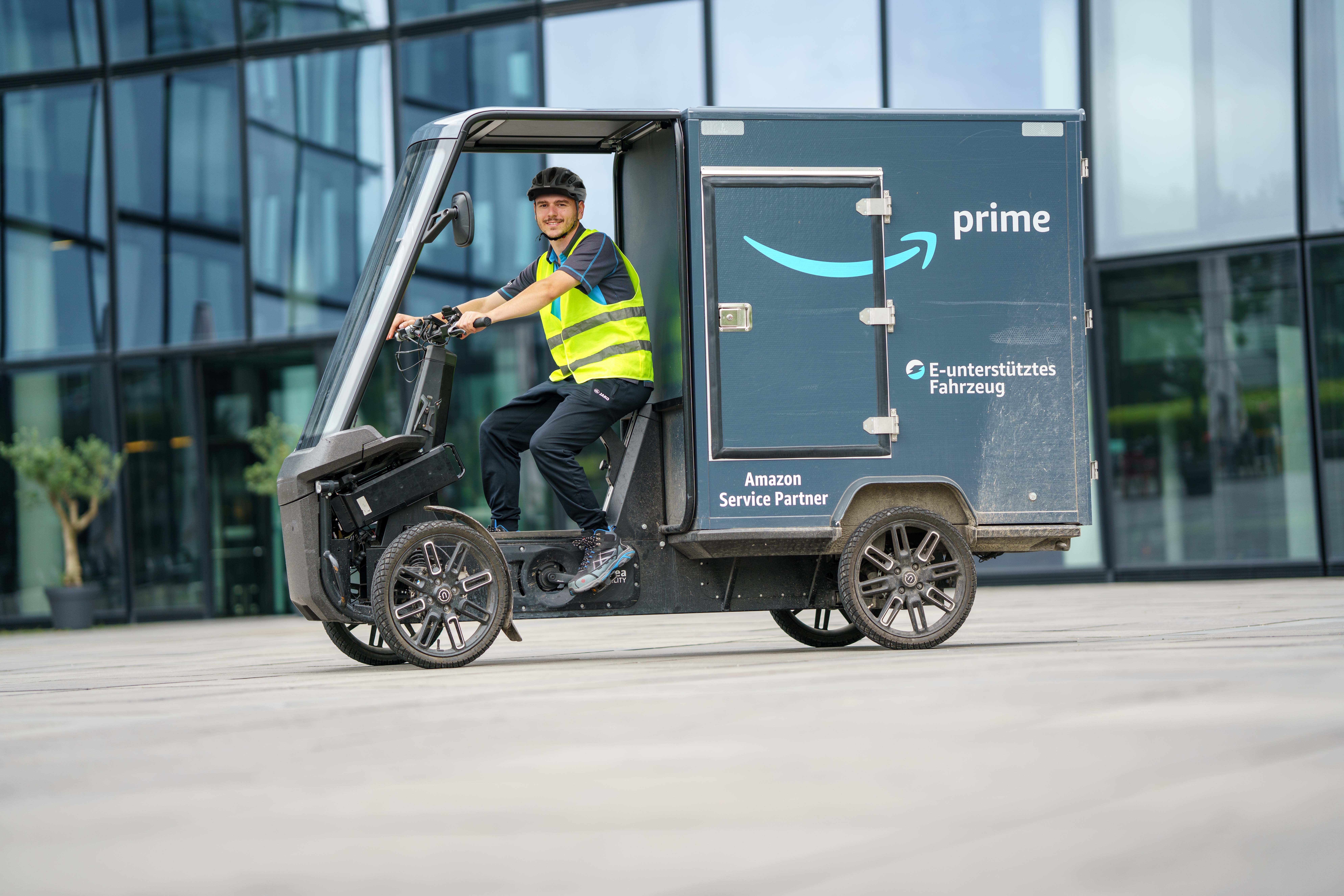
Text: Amazon’s electric cargo bikes have arrived in DC.
Image: A four-wheeled vehicle that appears to be a cross between a bicycle, a go-cart, and a mini-truck
Response text from high t alpha shemale @gluetaster: that’s not a cargo bike man that’s a loopholemobile
Edit: I found a slightly higher-quality version of the image:

That’s a keitruck without regulations.
What? you don’t like corporate-exclusive keitrucks?
Amazon: Kei for me not for thee
Nope, I don’t like corporate-exclusive keitrucks that skirt laws and regs. Keitrucks are the designed result of regulations.
Keitrucks are the designed result of regulations.
So exactly as this “cargo-e-bike”… especially designed to work within the existing regulation for cargo-e-bikes.
That is a stupid assumption to make and even more stupid that you’re trying to defend Amazon. It has 4 wheels, so it literally isn’t even a bike. This is obviously an attempt to cut some corner, probably trying to save on gasoline and shove more responsibility to the workers who aren’t being paid anywhere near what their labor is worth.
Having to actually defend Amazon is the bad part.
Having regulation that makes small(-ish) electric vehicles with certain speed limits count legally as e-bikes is exactly how you get efficient small electric vehicles to be used for the last mile of deliveries instead of stupid trucks.
That’s how Kei cars and trucks were established: special regulation for vehicles with limited sizes and power not counting as normal cars so being exempt from certain requirements, paying reduced taxes and insurance etc.
I don’t think there’s necessarily anything corporate-exclusive about these; you could probably commission your own if you wanted.
I don’t really see how this doesn’t count as a motor vehicle, though. Be interesting to see what the ‘assist’ speed and power limits are.
I looked up what constitutes an ebike in my state and it has to to be 750w or less motor and limit to 28mph with pedal assist. Has to have a front light and rear reflector like a regular bike. If you can go 30 or more on an ebike, its considered a motorcycle and you can be pulled over and need registration, insurance, license. This thing is gonna end up with many states adding vehicle weight limits.
28 mph is 45 kph and about twice the speed at which assist is required to cut out in Europe.
This thing needs weight limits and its speed halved. There should also be a momentum limit on speed times weight so a heavier vehicle has to go slower.
A power limit acts as kind-of an implicit momentum limit, although it can be more limiting going uphill.
Don’t let the perfect be the enemy of the good. These have to be far quieter and don’t pollute like cars. That’s progress!
By all means, do criticise Amazon’s treatment of workers and horrible policies in general. And yeah batteries are better than fossil fuels but still aren’t the greenest. But IMO anything that brings the US closer to bicycle culture can’t be all bad. Let’s accept a win when we see it and keep pushing, yeah?
The posts about Berlin and Finland are inspiring, let’s get others there too.
Okay, but what is pictured is a car sized vehicle that is going to be moving in traffic in the same place as cars, while simultaniously having fuckall safety features and no climate control. This is a fucking deathtrap, and just a new way to cut costs at the expense of working class lives. This is not progress, the is sacrificing people for the great capitalist overlords.
I don’t know how fast it’s meant to go, but it looks like it shouldn’t be going faster than 30 kph (20 mph). That is the speed that most city traffic should have. If this helps to make that the standard, that’s going to save far more lives than anything else.
Frankly, it is a loophole mobile unequivocally, but it’s a loophole that I would prefer that the laws change to accommodate rather than the other way around. “Deathtrap” is complete bs inspired by the same propaganda car companies use to justify bigger and bigger dangerous gas-guzzlers.
If we want any validation for this we don’t have to look any further than every other developed city in the world. This is just a more fuel efficient, quieter, more agile, and safer-for-pedestrians way to navigate a crowded city.
I get what you’re saying, and I agree it’s technically a good thing. But I have a problem with the fact that as noted, there’s no climate control, and no safety features. This will be on the roads with normal vehicles, doesn’t fit in a bike lane, and despite essentially being an efficient car, there’s no seatbelt. If somebody gets t-boned in one of these, or in any kind of wreck in general with a standard car or truck, they will likely die horribly.
I’ve no qualms with improving efficiency, but it shouldn’t come at the expense of safety for the vehicle operator who is being required to use this for work for likely many hours per day.
I think we could find something to complain about for just about any solution. I’m glad you agree that it’s technically a good thing.
I would be fine if we all drove these (and of course the infrastructure was updated to accommodate)
That is exactly the propaganda.
There’s the classic example that the car safety score is determined by whether the people inside the vehicle survive a crash. That leads to a perverse incentive in which car companies build a larger and more robust car to ensure their passengers survive crashes with no regard for the people they crash into. Since every car company is doing this they have to get bigger and bigger until we get the cars we have today that have to be registered as trucks.
These vehicles might be less safe for the drivers in our world of super-trucks, but they are magnitudes safer for pedestrians. I would prefer every effort to normalize smaller vehicles and I think every vehicle like this that’s on the road means one less pedestrian-killer and an overall safer experience.
From what I read, the reason (at least in US) why we got those big cars was the fuel economy requirements were more relaxed which made automakers who couldn’t improve it enough use it as a loophole.
It’s both.
pickups are also protected with tariffs
i don’t see how these being in bike lanes could possible be a positive
no one is using this to replace bigger vehicles, now you just have both
These things are at most half as wide as most modern cars so no its not car sized. Its not really bike sized either sure but its not just a car. Actual bikes both motor and pedal variety alreay cope fine in city traffic these are fine as well in terms of safety, maybe not in the dessert but otherwise its alright.
Of course its cost cutting at the expense of some comfort, but I’d much rather have this or any similar aliby cargo bike delivering in my neighboorhood than vans, even electric ones. These things are speed limited and the acceleration is fairly tame as well, the driver generally has a much better view than a van, and requiring the pedal input for forward movement makes the driving a bit more conservative/safe.
These should not be on standard bike paths they are just too big for that, but on pedestrianized/ bike streets these are infinetly better than cars for anyone except for maybe the driver, and on low ish speed limit inner city streets they are also just better than cars.
It is actually progress but its also just companies being cheap of course. I do see them as a genuine city quality indicators here in the EU, if they don’t exist it’s a sign the urban area is either pretty small or just super car centric.
These things are at most half as wide as most modern cars so no its not car sized.
It’s still car sized everywhere else. Cars in America are just needlessly oversized.
People need to remember that just because something is cost cutting, does not necessarily mean it’s worse. A great example is the move away from boxing things that are already boxed. So many people pissed off at it, but it’s just an easy way to be slightly better for the environment
A plus for the climate, a loss for workers.
Yep I would say you’re nailing the “criticize Amazon’s treatment of workers” part. That obviously is in severe need of fixing too.
Would you prefer if that got addressed but they stayed purely on combustion engine vehicles? I appreciate the idealism and in a perfect world we’d have both, but actually expecting both outcomes at once is sadly a tall order…
This isn’t a delivery bike. It’s for transferring cargo. That could have gone in a train or tram and been 100% electric while also not putting lives at risk.
You think the US has trains and trams that reach most neighborhoods? Not by a long shot.
No this is definitely looks like a last mile delivery vehicle to me.
You mean in the bike lanes.
that is going to be moving in traffic in the same place as cars,
Doubt. Bikers already have to contend with electric bikes, electric mopeds, and electric motos in the bike lanes so you can guarantee these assholes will be there too, especially if the automobile roads are jammed.
Ok but you have to somehow transport a lot of parcels, right? You need a certain size for that. There is barely any additional volume other than storage space and driver space, so this is about as small as it gets?
Sure, it’s about as small as it gets, at the cost of worker lives. Would it have become that much more bulky to give it at least minimal safety featues, like crumble zones, or doors that can be locked? No. It would however be more expensive for Bezos. He’d rather these workers die, than spend an additional bit of money to ensure their safety.
It is possible to have good electrified last mile delivery, while not putting poor people in literal death boxes, it’s just going to hurt the billionaire’s profits.
Ok I just compared it to the cargo bikes that delivery services use here in Germany, from the first look I thought they were about the same size - and they use bike lanes and are allowed to drive in pedestrian zones, etc. However, comparing them side by side I think the amazon vehicle is in fact a lot larger and probably too big to use a bike lane. In that case, it doesn’t make a lot of sense, yeah. Not sure though if it’s really that unsafe if it can only go 25km/h.
The USPS just got done ordering a custom-designed vehicle built from the ground up for efficient, safe, and comfortable package delivery. It doesn’t look like this.
Do you know vehicles exist that aren’t mini coopers?
Are these things going to be clogging up bike lanes and making biking more dangerous for people that aren’t working for Amazon? Are they going to have their “drivers” risking their lives on the roads with real cars? Are they going to be out there peddling hundreds of pounds of packages for 8 hour shifts in 90 degree weather? Oh but it’s quieter and less polluting… cool cool cool. The human endangerment is worth it then.
Are these things going to be clogging up bike lanes
You must not be from the US. Bike lanes here are empty, mostly treated as extra shoulder for cars. I’m not concerned about this one bit.
making biking more dangerous for people that aren’t working for Amazon
No, I feel confident that fewer motorized vehicles does not mean more danger for cyclists.
Are they going to have their “drivers” risking their lives on the roads with real cars? Are they going to be out there peddling hundreds of pounds of packages for 8 hour shifts in 90 degree weather?
Except for the peddaling that sounds suspiciously similar to current conditions. That needs to be addressed too, but I don’t think vehicle type alone is sufficient.
DC actually has a fair number of bikers around. It’s not as many as it should, but I’ve biked into and around DC, and it’s not bad. This will easily block an entire bike lane/trail/whatever though. This makes biking more difficult for everyone else, not less.
People seem more than willing to throw workers under the bus, as long as they know those delivery drivers are using an electric vehicle that doesn’t take up space or make any noise. Never mind that it’s summer and high-temp records being broken daily, get these guys out in that 98 degree heat so I can get my package delivered right to my front doorstep.
no AC and a singular water bottle. no protection for the driver either if someone decides to run up and drive off with it. Who thought this was a great idea?
Someone who will never have to use it, or likely even interact with someone who does
having worked at an amazon facility before, that is exactly how it goes, even the software is so stupid
better software than one of subsidiaries, wf. they are so behind the times, 3 different apps for employees,
That’s an Amazon driver. The water bottle is not for drinking.
But how you gonna piss with everything all open like that?
Very carefully
Maybe you can go in the back.
I always wonder how many unwashed piss hands have touched the packages I get delivered.
Possibly quite a bit less than you’d think, as I see many delivery people and those in fulfillment centers wearing work gloves of some kind. That said, there are always outliers.
You ever hear the stories about the TSA people who wear their rubber gloves into the bathroom to go piss and then don’t wash their hands before they go back out to rifle through you bag for a tube of toothpaste?
I’m kind of a germaphobe so I think about these things.
Can’t say I have, but given the average person’s propensity for laziness, I’m thoroughly unsurprised. Knew a medic that served aboard an aircraft carrier, and they regaled me with horror stories about how those things are nuclear-powered floating disease factories.
theres no bucket for the other hole.
Mail carriers die from heat stroke in similarly spartan vehicles every year here in the southwest, no question in my mind the same will happen with this.
I actually think it’s a good idea. If this is too dangerous then by definition the same is true for all cyclists. So there is no need to address those specifically instead of improving safety for all kinds of bikes.
This has giant blind spots. My bike has zero blind spots.
I will not pretend that this is very practical but it’s an e-bike. So it can’t drive in reverse. With properly set mirror there should be zero blind spots as the normal ones (low and to the sides and in front) are eliminated by the open cab.
saves amazon money, no need for expensive car insurance, or maintaing an actual ev/ice car.
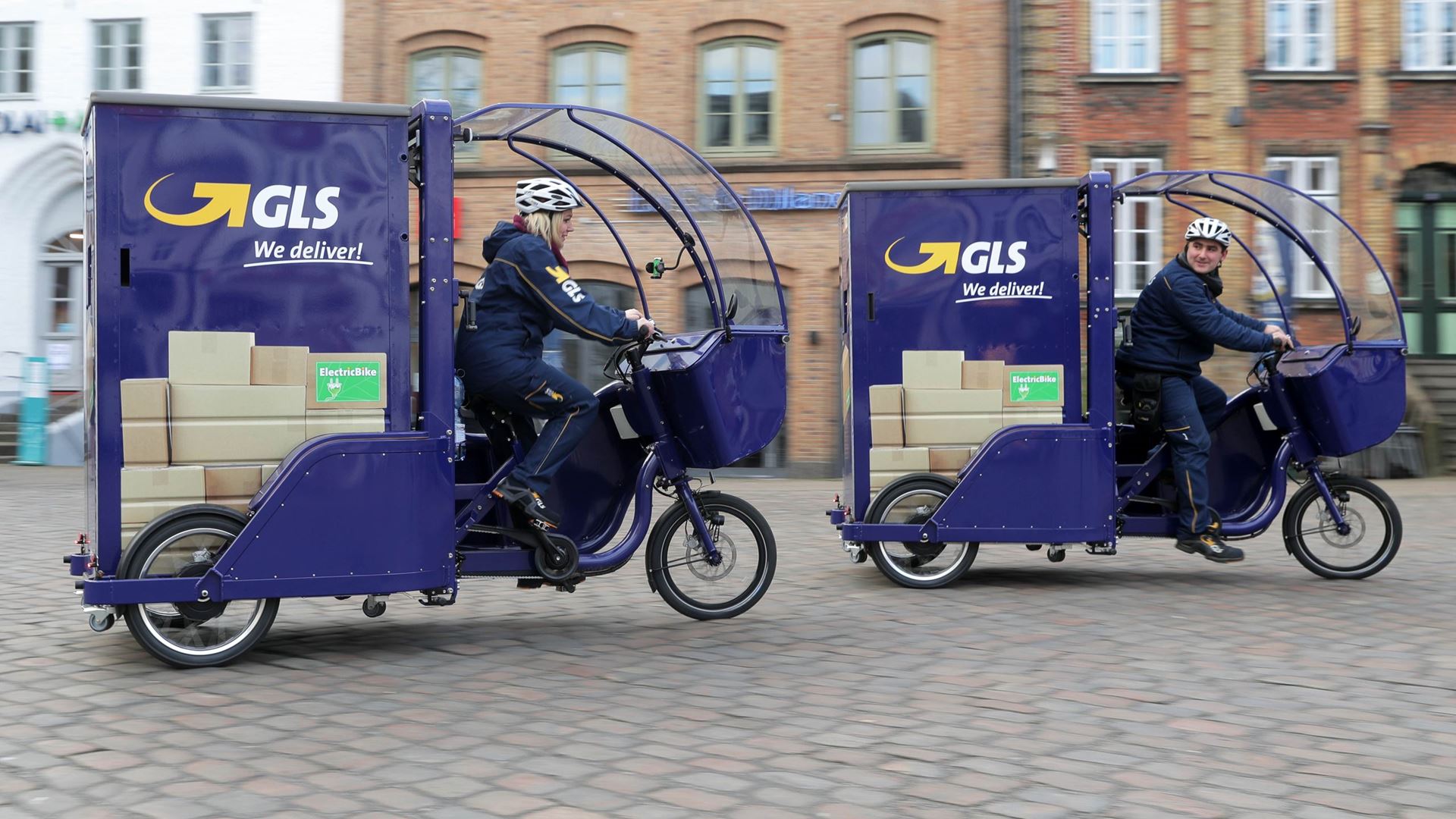
They’ve had a ton of these style of delivery vehicles around Berlin for years now. They work great, are really quiet, and solve the vast majority of last mile delivery needs.
That said, the one in that photo is huge. I’ve never seen one even close to that size. The ones around here look more on this scale:

Do they call them bicycles though? I’m guessing Amazon has chosen to call the DC one a “bicycle” (despite 4 wheels) because of some regulation they’re avoiding with it or (more likely) some kickback they get for using bikes.
I don’t have a problem with the vehicle itself. Seems pretty neat. But it is not a bicycle.
I wouldn’t be surprised one bit if it required the operator to pedal like all fuck to stay going, only because they can treat their workers like pack animals.
watch out for the piss bottles!
People are so wound up on the use of the word bicycle and bring stupid about the “bi” part for some reason. Germany regulates what’s allowed on sidewalks and bike lanes. Many types of personal assist electric and pedal-controlled vehicles are allowed to use the bike lanes and sidewalks.
The one posted by op would not be allowed in the bike lanes or sidewalks. It’s probably too big.
From a sloppy summary:
A four-wheeled pedal-driven delivery vehicle is legally classified as a bicycle in Germany, provided it meets specific technical requirements. Vehicles in this category are officially known as multi-track bicycles (or heavy-duty cargo bikes).
To maintain this legal classification, your delivery vehicle must adhere to the following rules under German law:
Pure Muscle Power: If it is propelled exclusively by human pedaling, it is treated exactly like a standard bicycle. It is subject to no vehicle registration, tax, or insurance requirements.
Electric Assist (Pedelec): If it includes an electric motor to assist the pedals, the motor must have a maximum continuous rated output of 250 W and cut off automatically once you reach 25 km/h.Vehicle
Dimensions: To remain in the bicycle/cargo bike category, the vehicle cannot exceed 2.00 m in width, 4.00 m in length, and 2.50 m in height.
No Throttle: The electric motor must only provide assistance while you are pedaling. If the vehicle has a throttle that propels the bike without pedaling (e.g., up to 6 km/h for walk-assist is okay), it can push the vehicle into a heavier moped class.
Because it is a bicycle, you can ride it in bike lanes, and you are exempt from needing a driver’s license. However, to be fully road-legal under Germany’s strict StVZO (Road Traffic Licensing Regulations), the vehicle must be equipped with:
Two independent braking systems (front and rear).A clear-sounding mechanical bicycle bell.
Approved lighting (white front light, red rear light).Required reflectors (white front, red rear, amber on pedals, and side reflectors).
If the delivery vehicle exceeds these power, speed, or dimension limits (such as having a motor up to 4000 W or reaching 45 km/h like an S-Pedelec), it is classified as a motorized vehicle. This would require an AM or B driver’s license, a license plate, insurance, and would prohibit you from using bicycle paths
Don’t post that shit here, assuming that sloppy means adapted from ai slop
Fine, then you can read the sources:
https://www.gesetze-im-internet.de/
https://www.gesetze-im-internet.de/stvg/
https://www.gesetze-im-internet.de/stvzo_2012/
https://www.gesetze-im-internet.de/stvo_2013/You’re welcome to them, but while it’s generated summary, it’s an accurate one.
Am i supposed to trust your word on that? Better to just not post ai in the first place.
You just blindly trust what random people tell you…? Lol people post bullshit all the time, ai or human yoy should be verifying the information regardless.
I would trust AI to not intentionally feed me bullshit over humans, ai only does that unintentionally and while following the example of humans doing it. Which is why you remove Reddit results, because places like this is where it happens.
It looks like a moped
Those ones are specifically designed to be able to fit onto bike lanes, no?
tbf they probably have to go on big busy roads a lot more in the USA, and there’s a lot more bigger trucks, and the drivers licence test is probably a bit less comprehensive than Germany, judging by how well people get out of the way of emergency vehicles in Berlin vs NYC in videos 😅
So you want a bigger vehicle just so you dont get squished by a silverado or something where the driver can’t even see the first 5m in front of them…
That sure is a tiny image. I wish I could make out what it’s about.
Lmao at the helmet. This country is a joke
it’s a bicycle helmet. if you were riding around d.c. on any kind of ‘bike’, you’d be the fool to not have one.
I mean, yes I know. It like, in what world is that a bike? It’s obviously just skirting the laws, and the helmet is a hilarious addition.
‘Lookit me! I’m on a bike !’
Yeah, sure buddy.
I think the pedals are even more hilarious. It’s not like the driver is going to be providing any useful motive power with them, or is going to be able to move that thing with the electronics not operating. At least the helmet has a chance of being useful by preventing the driver’s head from smacking the plexiglass windscreen in an accident.
Oh gosh, I didn’t even notice those! :p
Not comparable in the slightest.
These are fully man powered and tend to do scenic routes at a relaxed low speed. Don’t want people spilling all over. The driver can also see basically 360 around them and is incentivised to prioritise safety being responsible for a group of tipsy people. I don’t think there common either so los priority to make a new class label.
The amazon ones are electric, will go in normal traffic to go wherever the package needs to go, employee pushed to hurry up. the priority will as always be the speed of gaining profit. Barely able to look behind. And if these test units are deemed good they will start popping up every.
Of course when its about the pure label, both legally seem to pass for bikes and neither actually should.
Lol, they do the exact same thing. You limit one, you limit the others, they’re built around the exact same bicycle laws. To say they aren’t comparable is missing the entire bloody picture here.
And the article goes into how not every party bike is for drinking… you’re clearly missing the point if you’re bringing this up.
The others aren’t electric, they’re pedal assist, just like these can be too. Once something’s a bike, there’s other limiting factors to get into, but these are both bicycles for the sake of relevant laws. Why are you saying they aren’t comparable?
Both can go in bike lanes or in regular traffic lanes since they fit the definition of bicycle, which means they must actually be on the road like bicycles in most places.
You’re now just making shit up to make a point. Well done.
Sorry but who hurt you? No need to be rude.
My last sentence was pretty clear that when it comes to current legal label they are the same, The same as your personal bike even. To the law these are all comparable. Can ride on bikelanes, dont require any traffic license. (At least where i live)
Except your article does state some places do treat them differently:
In some locations, the driver is required to have a chauffeur’s driver’s license to operate on public streets.
But my point is they should not count as the same at all and thats an opinion i am free to add to this discussion, they are build differently for different usecases. They need their own respective laws fit for the areas they ride, size and max speed. There is nothing safe about allowing these on bikeslanes.
I would even say for party bikes, they don’t all compare among themselves either.
If they don’t, than courier bikes are banned, children carts are banned… these are based off courier bikes that already exist, pushed to the limits of the legislation. Just like anything else ever made really.
They have size limits and other limitations, they’re being followed, so they are defined as a bike. What about accessible four wheeled bikes for the less abled, Oops your ignorance just got those banned, well done.
Don’t like it, go cry somewhere else. You are mad at Amazon, not the legislation, go whing to someone who cares.
Yeah the first time one of these is t-boned by a Camaro I’m sure the helmet will do the trick
You understand the helmet is for if you fall out… yeah? Or other scenarios. A helmet does no good with a regular bike when a car hits you too.
So just like any other bicycle that would be in the same situation…?
What’s your point?
Most bikes aren’t the size of a minivan, genius
Those absolute animals! No helmets!
I mean in other countries they have different laws. Don’t wear them in a rickshaw, but if those existed in NA legally you probably would need to.
They have a sorta rickshaw where I am, I don’t remember the pullers nor the riders having helmets. Though, no clue what the laws would be. Even if there are some, they aren’t enforced.
It gets worse, some cities even have specific bylaws too. So going from city to city in my province you could be breaking the law or be perfectly legal.
Can still fall/be ejected sideways.
We have quite a few companies in Germany using similar vehicles in cities (I can’t compare the sizes here). All in all it’s a positive development. Maybe in this case it’s a way to utilize a legislative loophole, but even then I would say: The loopholed law has a positive impact if the new vehicles are smaller and more energy efficient than the ones they replace.
I think the larger issue is that most places in the US just don’t have bike lanes at all, and the coverage even in major cities is pretty spotty. So routinely bikes end up on sidewalks to keep from getting run down by F-150s. Legally bikes are allowed on all non-highway roads here and have the same rights as cars, but as my grandma used to say “they’ll put that you had the right of way on your tombstone”.
So these things will end up driving on sidewalks. And then people will want local governments to ban bikes from sidewalks and enforce those bans harshly, so bikes will have to enter mixed traffic on busy streets with no bike lanes, and less people will bike because don’t want to risk getting plastered by a pickup, and then the existing bike lanes will get ripped out because not enough people are biking to justify them.
Like, medium sized vehicles like this are great, but, the bike infrastructure just isn’t ready for them here. Better off using a Kei truck for the same type of work.
I deffo feel the same way here. Ultimately it’s probably a net positive, but people who bike there are gonna be piiiiissssed.
Meanwhile in Germany:

I visited Hamburg (number of years ago), and I couldn’t believe how much worse the bike lanes were compared to my pretty car-centric city’s bike lanes (Melbourne, Australia).
A bike tour through Italy opened my eyes to this.
There was no usable bike infrastructure at all, most of the time.
One of the campsites we went to was only accessible via a 4-lane road with dividers.
But drivers crossed all the way into the other lane to pass us. At one point, a driver stayed behind us and put his hazard lights on when passing wasn’t possible, then gave us a thumbs-up when he could pass safely.I’d rather share the road with drivers like that than have German bike lanes and German drivers.
Of course I’d much rather have Dutch bike lanes and Dutch drivers.
See what? I can only see red looking at this. Bastards!
Loopholemobile, oh yeah for sure, still waaayyyy better than a whole ass SUV.
I am amazed at how this is mostly not mentioned in more upvoter comments. If kei trucks were not outlawed in the US
for having the driver see the road too wellthis wouldn’t exist, most likelyI actually just saw a kei truck in fucking Arkansas of all places!
Smaller trucks would make more sense and be better for the drivers aswell, though overall we’re marginally against same day/next day delivery. That way drivers and workers can take more time and not be rushed delivering things constantly
As someone from elsewhere I can’t even imagine same day delivery, tbh
Amazon offers it in nyc and it usually results a lot of their warehouse deliveries spilled across the sidewalks
Aren’t SUVs the loophole mobiles? They’re classified as trucks to avoid the gas guzzler tax.
They’re loophole mobiles too! They should just introduce the same rules as Japan and aspire k cars to flourish
The shit us Americans will do to not just fucking use Kei trucks like the rest of the world.
I don’t think these are a problem. They deliver mail and parcels with kind of similar vehicles here in Finland, though I grant that ours are a little bit smaller.
If there’s a problem with these, it’s that legislation doesn’t properly recognize a class of vehicle smaller than a car but bigger than a bicycle. That’s not to say these vehicles shouldn’t exist, and stuff like this rightfully shouldn’t have to follow the same rules cars do (because, well, it’s a lot smaller, lighter, quieter and slower).

NZ Post has somewhat similar Paxsters, but they have full roadgoing registrations and license plates. I think they might have their own categorisation or exemption to allow them to legally be driven on footpaths like posties on motorbikes. Not used for parcel service, only letter mail
The mistake is looking at this through the eyes of not being American, not having to work for Amazon, and a postal service vs whatever Amazon deliveries is.
This is Amazon, looking for loopholes to use cheaper vehicles. That’s it. Minimum, if any, safety for the driver while they’re going around major roadways with vehicles that outweigh that thing.
So to recalibrate… think of the most evil person you can. Cool, now double it. That’s Amazon as a company. They can and will do anything they can legally get away with or if profits outweigh the fine(s).
Still doesn’t make these vehicles a problem per se. And it definitely isn’t a problem that should be addressed specifically. Instead tune the laws and regulations for e-(cargo-)bikes accordingly to benefit all ebikes and other future ideas to exploit loopholes.
My first reaction would be: great!
Then I remember it’s Amazon we’re talking about, so it’s pretty safe to assume there is some fuckery somewhere going on…
I would say so they can use bike lanes as well as the road, so say hello to essentially a small van to dodge in your bike lane
I’m fine with these as long as they don’t use the bike lanes. Nothing with more then two wheels should use the bike lane because:
- You can’t pass them or let them pass you
- They seem less safe. They aren’t quite car levels of soundproofed bubble, but they have significantly less awareness then a bike since you cant see behind you without a mirror. They are also going to weigh a lot more and the more mass going into a crash the worse it’s going to be.
I would give actual quads and trikes a pass still but not these. Not everyone is physically capable of riding a standard bike and I will almost certainly lose the ability in time.
*“I’m fine with these…” *
You know the entire point here was likely to deny the drivers climate control and whatever X continuous hours of operation before mandatory 12 hours away type laws apply to people who operate vehicles professionally? They want people to burn/freeze and frantically move until they die on 72 hour shifts without overtime pay.
100% they don’t want to pay for air-con. That can get expensive in the summer months. Better to remove the option all together.
That’s idiotic. The point of these is to drop their carbon footprint. These are a good thing.
“Drop their carbon footprint”
Bezos laughs at you while he takes a helicopter to his jet to another helicopter to the smaller yacht that transports him to his actual yacht.
Still stuck on bezos when he isn’t in charge anymore eh. Maybe figure out there are many others involved.
Jassy shit in your milkshake. You’re not getting invited to the yacht party BTW, you temporarily embarrassed millionaire
Nope. I just know that there are many others getting rich as fuck and bezos isn’t CEO anymore. People get distracted by one person and don’t blame the entire C suite or the board.
Oh yeah, because Amazon has such a great trackrecord of wanting to reduce their carbon footprint.
They do. Out of most companies they do. Fuck them for so many things. But they are the only company using a huge fleet of electric vehicles and other ways they have reduced things.
Exactly. The problem with these is them monopolising bike lanes. Apart from that they’re better than trucks in every way, quieter, less polluting, less dangerous, don’t emit cancer fumes.
I guess trikes and recumbent bikes are out for you then right.
They should be allowed

Why the world doesn’t switch to mostly vehicles like this is fucking dumb. Hate amazon but support more vehicles like this.
How to test if it’s actually a bicycle:
I propose a simple ontological test by law enforcement. Simply steal one. If the police treat it like they do bicycle theft, it’s a bicycle. If the police treat it like it’s an auto theft, then it’s an automobile.
If the police take the theft of one of these seriously, like they would a car theft, then point to that as justification for why they should be regulated like autos and banned from bike lanes. If the police treat it like bike theft…well…there’s a lot of valuable materials in those loopholemobiles…and the police clearly aren’t taking theft of them seriously…so…well the problem will solve itself.