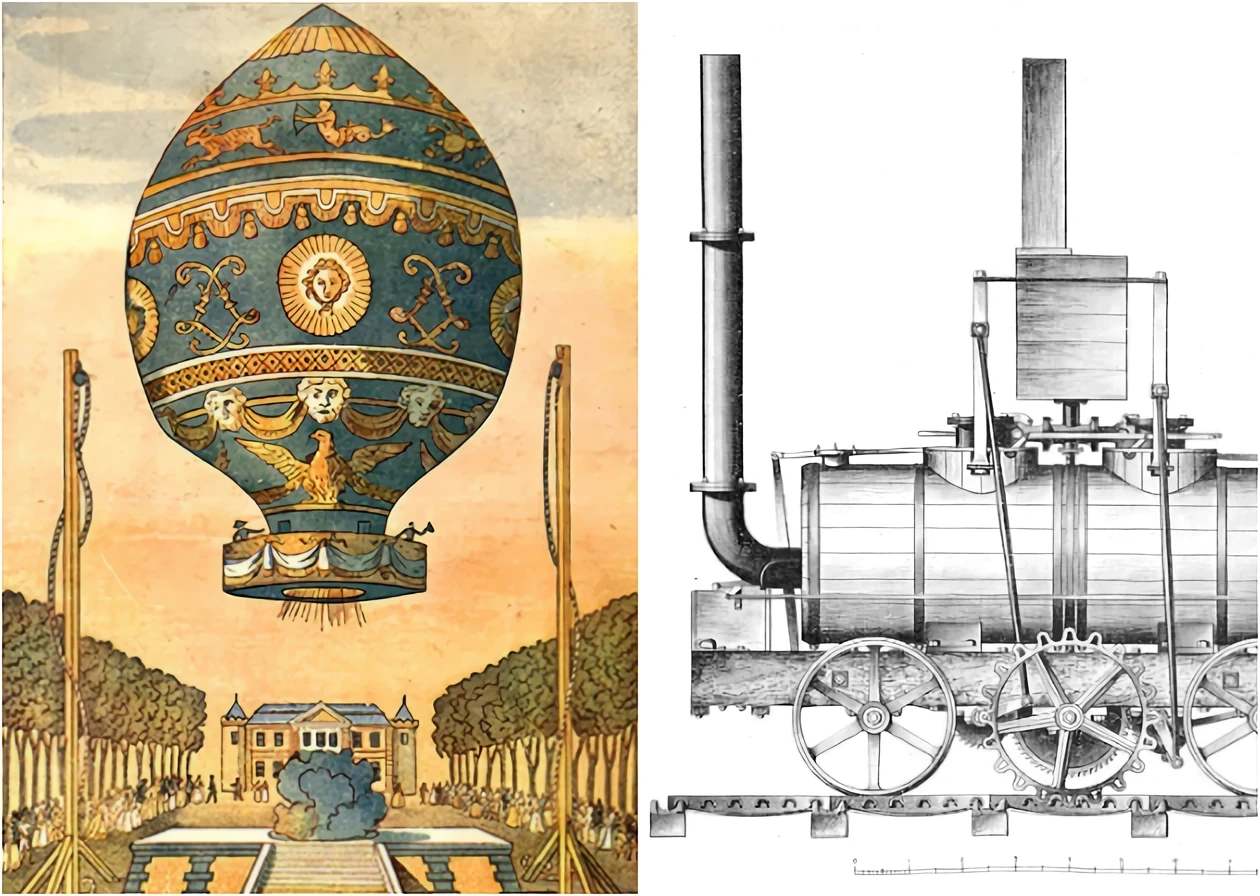

https://piefed.social/post/2215171/comment/12141440#comment_12141626
Many late-coming technologies are issues of concept. Slow-sand filters are incredibly simple, for example, but require an understanding that did not arise until the 19th century (some possible examples in Mesoamerica excepted). Gliders are not actually particularly difficult to acquire the materials or tools to make, especially in cultures that use kites, but require, again, an understanding of the principles involved to provide controlled flight (with gliders requiring precise balance of lift and drag, whereas kites primarily need only light weight and wind stability). Fire pistons are conceptually advanced and were not discovered in Europe until long after they were in Southeast Asia, despite some Southeast Asian cultures which produced and used fire pistons being literal stone-age cultures, in terms of available material tools.
Hot-air balloons, I would imagine, follow the same principle. If you lack the concepts behind the invention, the only way to discover it is by accident, which is generally unlikely. It’s why so much material development is concentrated in the modern and early modern period - we started to piece together how the world, on a fundamental level, works, beyond pure trial-and-error.
Also, hot-air balloons before plastics were often made of silk (and rubber), since most other materials are either too heavy (at least for practical purposes) or too thermally sensitive, and that’s an expensive experiment to be undertaking if you haven’t the first clue how it works.
In some ways I think the printing press was the most important invention ever conceived. It enabled the mass spreading of knowledge.
humanity needs time to mature like a dough in the fridge before you bake it.
It even features a flared base…
In my uninformed view I came to a different conclusion. Lack of technical development until recent history is more of a problem of materials science first and easily accessible/cheap energy second.
We classify ages of humanity by advances in material science. Prehistory is noting advances in humanity using ceramics as signs of advancement. “The Bronze Age” when humanity figured out that combining copper and tin produced a metal stronger than either alone. This lead to “The Iron age” where mining and refining metal produced even stronger tools and allowed humanity to access/create even stronger/lighter/cheapers materials. Refined Aluminum was more valuable that gold (I think) when it was first discovered and isolated.
Humanity advances with better materials unlocking yet more better material.
But the Bronze and Iron Age did not lead to one another. In fact, much of Subsaharan Africa lacks a Bronze Age entirely, precisely because they don’t lead to each other - the forms of furnaces (bloomeries) that spread in Subsaharan Africa were efficient enough to smelt iron from the start. Bronze is not needed to smelt iron - bronze or iron tools (though obviously you still need the iron itself) are not even needed to smelt high-quality steel, if you really know what you’re doing - all you would need are earthen furnaces, clay crucibles, coke (processable, if you know that it can be, in earthen kilns), and flux.
Theory does a lot of lifting that we often don’t appreciate.
First, I don’t claim to be a historian, but if you’re willing to indulge the exploration of the topic from my limited knowledge I’m game to do the same.
In fact, much of Subsaharan Africa lacks a Bronze Age entirely, precisely because they don’t lead to each other - the forms of furnaces (bloomeries) that spread in Subsaharan Africa were efficient enough to smelt iron from the [start.
According to this link those first Subsaharan bloomeries were from the 6th or 7th century BC placing them well after the Bronze age from about 1000 years before. In this way it doesn’t look like they had the technological insight to skip the Bronze Age discoveries, they were just recipients of the technological advances from other parts of the world. Iron bloomeries were already in use elsewhere in the world over 1000 years before Subsaharan bloomeries.
I’m also not arguing that technology or technological development is evenly distributed across the whole of humanity. An example being ancient China was well versed in gunpowder hundreds of years before other areas and Europe was the recipient of this technology from China later.
Theory does a lot of lifting that we often don’t appreciate.
No argument to that statement. I would argue that materials science is even more underappreciated.
According to this link those first Subsaharan bloomeries were from the 6th or 7th century BC placing them well after the Bronze age from about 1000 years before. In this way it doesn’t look like they had the technological insight to skip the Bronze Age discoveries, they were just recipients of the technological advances from other parts of the world. Iron bloomeries were already in use elsewhere in the world over 1000 years before Subsaharan bloomeries.
Bronze Ages are regional; Subsaharan Africa lacked any such distinct Bronze Age in its history. Subsaharan Africa is suspected to have begun working iron and bronze effectively simultaneously in most areas, with some suggested dates as early as the 2nd millennium BCE, and a few outliers in the 3rd millennium. Furthermore, the design of bloomeries in Subsaharan Africa is largely autochthonous to the continent, without clear links to bloomery designs of North Africa or Eurasia.
The point is entirely that there were no “Bronze Age discoveries” other than bronze; the discovery of bronze defines the Bronze Age, and very few material technologies are linked to the usage of bronze, specifically. Iron has somewhat broader uses, but in most cases other metals can be substituted, in principle if not necessarily scale. The reason why so many cultures end up with a Bronze Age and an Iron Age is because bronze and iron are incredibly useful military metals, and if any of your neighbors have bronze or iron, you will learn from them very quickly, or else be very quickly conquered by their elites.
“Bronze Age” covers an incredibly wide variety of societies, as does “Iron Age” - the only unifying factor between such societies is the discovery of bronze or iron. In fact, of the two, I would regard “Bronze Age” as much more meaningful, as widespread use of bronze usually implies long-range trade routes, which in turn imply relatively robust state structures to ensure trade routes remain viable. “Iron Age” societies run the gamut from the incredibly urbanized and developed proto-industrial Roman Empire, to early nomadic Bantu tribes which rarely numbered above the low thousands.
Again, no technologies of the Bronze Age are necessary for the discovery or development of iron. If the first viable furnace in a region that is developed can reach temperatures above not just bronze, but also above the point needed to make iron bloom, there’s no need for any form of intermediate stage - and bloomeries do not require any metal tooling to be designed or constructed.
For that matter, China, for instance, is generally considered to have skipped bloomeries entirely.
Technology is not linear.
No argument to that statement. I would argue that materials science is even more underappreciated.
Materials science is the main thing most people consider when thinking about the conditions of the past, along with engineering/design, often to the exclusion of theory and organizational technology.
and if any of your neighbors have bronze or iron, you will learn from them very quickly, or else be very quickly conquered by their elites.
I wouldn’t even go that far. Having iron weaponry when your opponents have bronze is an advantage, yes … but I really doubt that it’s a decisive advantage. It’s not like a bronze-wielding army is suddenly going to become helpless against a foe with iron weapons. If the bronze-age army has better numbers, better tactics/strategy, and/or better motivation, they may very well defeat an iron-age enemy in battle.
Still, though, they definitely are going to notice the other guys’ iron weapons and figure out that iron is superior. And at that point, they’re going to be highly motivated to find out how to make some of their own. So even if the bronze-age side wins, they will probably be adopting iron very soon afterward.
I wouldn’t even go that far. Having iron weaponry when your opponents have bronze is an advantage, yes … but I really doubt that it’s a decisive advantage. It’s not like a bronze-wielding army is suddenly going to become helpless against a foe with iron weapons. If the bronze-age army has better numbers, better tactics/strategy, and/or better motivation, they may very well defeat an iron-age enemy in battle.
A few times, sure, but on a historical scale, it’s a ticking time bomb. One of the advantages of iron, other than being significantly superior for usage in edged weapons (armor is a mixed case), is that it is much more plentiful and cheap, and doesn’t require distant supply lines to be maintained in war time in most cases.
“Their swords are better than our swords” is bad, but not necessarily spelling doom. “Their swords are better than our swords and they can make 5x as many for the same time and cost, and they aren’t reliant on their trade ships not being pirated or sunk by storms to continue making them” is a bit dire.
It may be worth pointing out that the metal ages are used primarily for old world archaeology. The Americas utilize a different system that isn’t so bound to metallurgical ages.
Lithic > Ancient > Formative > Classic > Post-Classic
Each era is about mlre than material sciences, and specifically metallurgical ones, of the old world. (But let’s be clear, the Bronze age is so, so much more than bronzeworking. Sometimes that gets lost in the nomenclature.)
Arguably one could apply the american measurements similarly to old world history too, since these are all approximations for coherent discourse.
In the 1800s you suddenly had a middle class where farmers, small business owners, and local artisans had access to a wide variety of tools and books, things their ancestors could have never afforded.
In my uninformed view I came to a different conclusion.
I mean… yeaahhh?
Is there a tendency to assume ‘everything should have been possible in antiquity’? What is that supposed to mean?
Nonetheless:
There are plenty of examples of inventors through history with concepts and ideas that were not really practical in their time. Leonardo da Vinci’s airship concept comes to mind as a well known example. Atomism is an another ancient concept across cultures east and west, which was conceptually used in the development of modern atomic theory. I think the Turks invented the steam engine based on Hellenic Greek concepts, but it was the English put it to state-level use and implementation.
So there’s just a long history of technologies being adapted and improved for different purposes. Ballooning is a good example of something that has existed for many centuries in Asia. Lifting a person into the sky, instead of a message, is a newer concept that branched off an existing technology.
A great deal of technological advancements have been out of military necessity/value, such as with the balloons, but the prerequisite for innovative adaptations of technology have simply had to do with how well they were recorded and disseminated throughout populations. Militaries have been pretty good about learning a thing and getting a group to do that thing, and then recording itnfoebthe next time.
So with that in mind: Large scale education with writing and reading is a pretty late stage development. A chinese manuscript translated into English for someone who could read it occurred once every a few millenia for most of history, picked up to a few decades in the 1800s, and now that likely happens many thousands of times a day today.
Is there a tendency to assume ‘everything should have been possible in antiquity’? What is that supposed to mean?
A user posited the question of why hot air balloons were not invented sooner despite the materials and tools being available.
There are plenty of examples of inventors through history with concepts and ideas that were not really practical in their time.
How is that in any way contradicting what was said?
Atomism is an another ancient concept across cultures east and west, which was conceptually used in the development of modern atomic theory.
… that’s literally a question of theory. On both ends of the equation.
I think the Turks invented the steam engine based on Hellenic Greek concepts, but it was the English put it to state-level use and implementation.
The Turks invented what is called the steam jack, which is distinctly different from the atmospheric engine used in English mines some ~150 years later. The steam jack is much closer to the aeolipile; the atmospheric engine which was instrumental in the industrial revolution was based on fundamentally different theory.
So there’s just a long history of technologies being adapted and improved for different purposes. Ballooning is a good example of something that has existed for many centuries in Asia. Lifting a person into the sky, instead of a message, is a newer concept that branched off an existing technology.
Except it didn’t branch off from an existing technology. The early European attempts at ballooning, which led to the hot-air balloon being discussed, did not originate from the East Asian practice of kiting or sky lanterns.
A great deal of technological advancements have been out of military necessity/value, such as with the balloons,
… ballooning did not start out of military necessity and was not even taken seriously by most militaries of the day. The French Aeronautic Corps lasted maybe a decade; ballooning in the US Civil War was taken seriously until internal politiking wrecked it. Very little investment in ballooning was done by or for military purposes.
but the prerequisite for innovative adaptations of technology have simply had to do with how well they were recorded and disseminated throughout populations.
That’s not a question of invention, which is what was being discussed.
Militaries have been pretty good about learning a thing and getting a group to do that thing, and then recording itnfoebthe next time.
You’re fucking kidding, right?
Militaries as standing institutions do not even date back before the 17th century in most parts of Europe, unless you want to go all the way back to Rome, and effectively many were not really created until the 18th century.
Militaries, historically, have been horrible at learning, recording, or getting people to do something specific. The modern institutionalized military that is competent at that is an extremely recent development.
A user posited the question of why hot air balloons were not invented sooner despite the materials and tools being available.
Ah. It seemed like a vague question so without context it was confusing to respond to. The context helps, and so much of what I wrote was based on trying to understand the framework to begin with.
How is that in any way contradicting what was said?
It wasn’t really. There’s usually a common thread and history to technology where their concepts are translated and travelled. Like you have signal balloons being used in China, which the Mongols adapted, which the Poles witnessed and recorded, which was how it came to be known in in Europe.
Comments aren’t always contradictory or a refutation, so taking them as such is going to cause some unnecessary grief.
Well said!
Large scale education with writing and reading is a pretty late stage development.
Correction: a weirdly recent development in Sapiens, but go for it…?
Sapiens
As opposed to…?
Other humans, other apes, other mammals?
What exactly are you trying to ask…?
Keeping the discussion exclusive to humans is typically just assumed, so to add a correction of ‘Sapiens’ felt a bit odd, is all.
No other humans than H. Sapiens existed in history, they all went extinct prehistorically.
hot-air balloons before plastics were often made of silk (and rubber), since most other materials are either too heavy (at least for practical purposes) or too thermally sensitive, and that’s an expensive experiment to be undertaking if you haven’t the first clue how it works.
I have no idea how old “Chinese lanterns” (small hot air balloon carrying a candle) are, but I assume very old. Concept behind hot air balloon understood. and the most basic imagination would understand the scaling potential. That they also dominated silk supply would require a different explanation for why human basket sized balloons took so long to develop.
Sky lanterns require an open and continuous flame, which is considerably more troublesome to combine with cargo of any sort. Early manned hot-air balloons were filled by gas generated on the ground, which requires an understanding that it is the gas which generates lift through buoyancy.
Concept behind hot air balloon understood.
I’m not well-read on the history of Chinese scientific thought, but it could very easily fit into what I said in the comment: "If you lack the concepts behind the invention, the only way to discover it is by accident" That’s how most things were discovered before early modernity.
Knowing how to make something, especially something discovered by accident or passed on by practice rather than taught as an application of theory, is different than knowing why it works, and understanding why something works opens up a much broader range of applications and elaborations.
A very simple theory of innovation/development is cultural, specifically whether your empire will make you rich for developing military applications, and control more heretical heatens. Motivation for the Wright brothers would simply have been great empire/government rewards for success. Eastern cultures were less expansionist driven.
A very simple theory of innovation/development is cultural, specifically whether your empire will make you rich for developing military applications, and control more heretical heatens.
… simple to the point of absurdity.
Motivation for the Wright brothers would simply have been great empire/government rewards for success.
Fucking what.
Eastern cultures were less expansionist driven.
I really hate the re-emergence of orientalism.
Realistically, war is the only time a society is going to focus all it’s resources on a single goal.
I would replace “war” with “defense,” since we do a lot of shit to stay “safe.”
War is peace.
Yes, that’s how war works.
On a tribal level, it’s just survival.
On a nationalistic level?
It’s legitimate-patriotism!
From there, the reinforcement of hierarchy
leads your blind horse right up to 1984.Reminds me of an interesting fact.
During WW2, the USA, with almost unlimited resources on hand, decided that pianos weren’t a good use of resources. They closed down all the piano factories and used things like piano wire for aircraft control systems.
Germany, with fewer resources, kept building pianos throughout the war.
Similarly, the De Havilland Mosquito was made mostly out of wood in part because of material shortages, but also in part because it was realized that in the UK’s total war situation, woodworkers, including furniture makers, were an undertapped labor source.
Wood is also the historic material of choice for aircraft, before aluminum became the mainstay, because of its strength to weight ratio. In the era of biplanes which were basically wood frames covered with fabric and held together with string, the compressive strength of the framing members mattered.
Wood fell out of fashion from aviation when airplanes started to build around a fuselage, and while wood is strong for its weight, you cannot build a thin-walled wood fuselage and expect it to work, especially if pressurized. But you can with aluminum.
As a side note, we’ve actually had this very similar discussion on materials available to the Roman Empire lol: https://sh.itjust.works/comment/20986879
If the Empire had aluminum, my goodness the world would look very different.
If the Empire had aluminum, my goodness the world would look very different.
I’m not so sure… What do you think they would do with it?
As for almost all weapons, iron is better than aluminum. It’s heavier, but much stronger and holds a sharp edge better. Maybe they’d use aluminum in armor? When used in armor, being lightweight might be worth the cost of being a little less strong. And if you just make it thicker, you can have armor that’s both lighter and stronger than iron armor. (And best of all would be composite armor that’s mostly made of aluminum but has a very thin sheet of iron on the top layer for better piercing resistance.)
Industrially…? I also don’t see what they’d get much use out of aluminum in. Unless it’s in an application where weight reduction is critical, iron would be a better choice than aluminum. And without powered vehicles, especially without flight … what application do they have for weight reduction? Maybe they could use it in chariots and wagons and the like … but I can’t see slightly lighter chariots decisively changing the course of history.
Now that’s a wild idea.
Watch Bakshi’s American Pop sometime if you get a chance.
I liked that movie, but the end almost killed me.
All those great songs throughout, and then the generations are redeemed by that piece of garbage?
I assume you’re talking about the guy playing piano in the middle of a battle?
Yes, he was a bit emblematic.
You’re right.
How many times do I have to block dude?
The same amount of days he’s been here while saying he’s leaving. So we’re sitting on 7 days of “I’m gone for good.”
About as many as that c002 dude
Explain, please…?
He’s a power user that has a fan base and a hater base.
I’m not the biggest fan but compared to Reddit power users pug is fairly benign.
Pug is such an awesome source of history that I’m baffled why anyone would possibly have a problem with him…?
He has opinions not everyone likes, it happens to everyone he’s just so visible people notice his opinions more than say mine or yours.
Being a marxist and a socialist I am not a fan of his enlightend centrism and his constant assault on leftists in general and communists in particular. Since I’ve blocked him every where I can, I cannot give you any links. I don’t use alts. (I’m mostly a lurker anyways)
However I am also a historian and let’s just say history is always up to intrepedation and while the user is both funny and clever, they are not necessarily right. And I am really not on social media to get rage baited, and so I block people who are persistently annoying.
I just forgot about them and wished it had stayed that way
This is… stuff I’ve never been hearing before…
What’s up, then?Being a marxist and a socialist I am not a fan of his enlightend centrism and his constant assault on leftists in general and communists in particular.
Sorry for loving Marx but hating Stalin, I guess. Peak centrism.
He’s a power user that has a fan base and a hater base.
Also, WTF “POWER USERS” are there possibly across the FV…?
Is that like saying that the whole thing was a fraud to begin with…?
“Power user” just means “User which uses the service significantly more than average”
Which, tbf, I was.
Oouyh.
I taped a bigass filter to a boxfan I was saving for a completely different project, and am now… feeling not so weird?Carry on, then.
I must admit that the way you casually, lightly-stroll through… umm, stuff… is certainly quite instructive. It’s absolutely incredible, frankly. I’ve rarely seen casual ownage on that scale, altho of course the concepts are much larger…
Just tankies whining.
In three years, I’ve had three accounts that I’ve actually used to any serious degree.