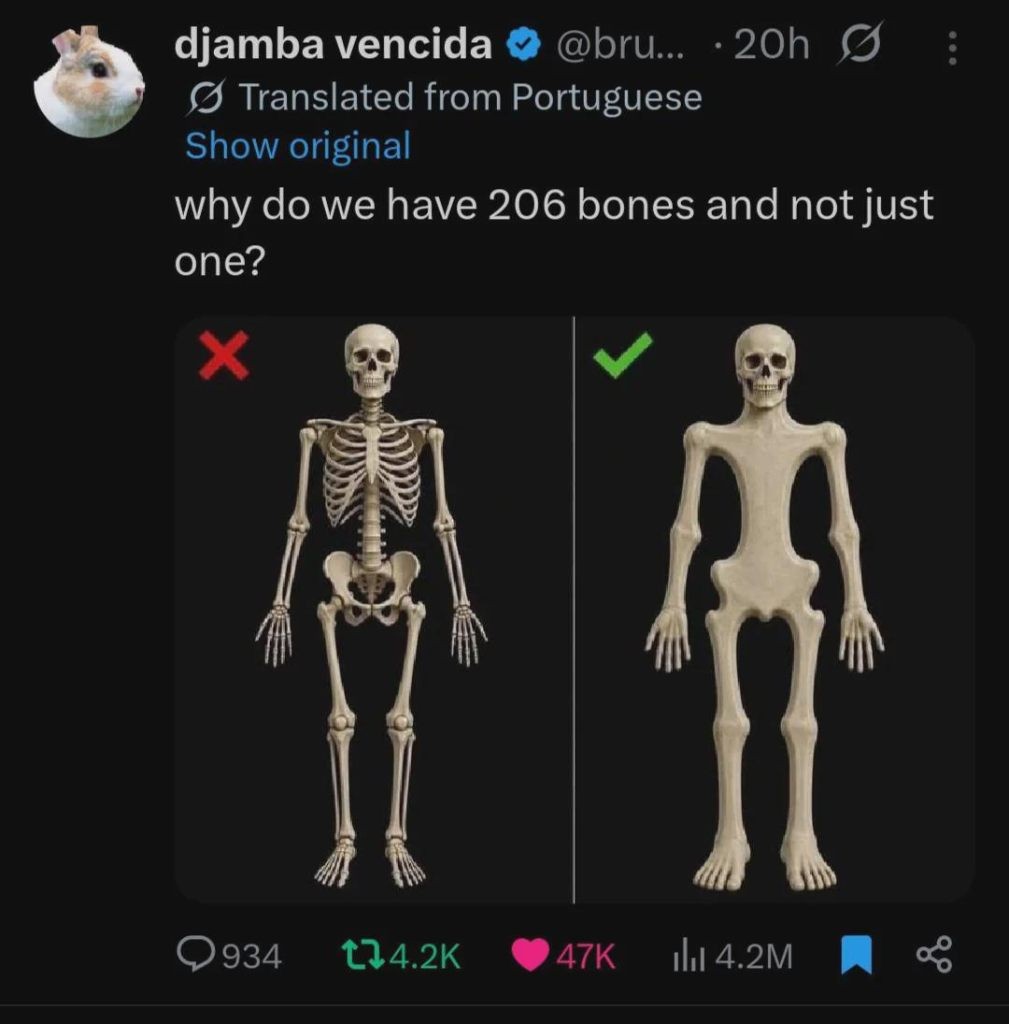

Why not none? Bones are a terrible affliction.
bnone
You can add new bones to your body any time you please
Are you hitting on me??
( ͡º ͜ʖ ͡º )
more like hitting your jaw to ameliorate the human affliction of “only one jawbone”
I already have boneitis. If I could just get rid of my bones…
I’m having my doctor remove mine,rather i’m trying to he’s not being very cooperative
OP’s mom doesn’t seem to mind
Fuck off with your bullshit again, octopus. We don’t have a damned choice.
I’ve been found out!
- ink cloud go! Swimaway swimaway!
Adjusts monicle and puts flat cap back on. That some of a bitch… We were so close this time.
I’m having flashbacks to creationist boner dinosaurs
The human body evolved for resilience: having a large number of bones provides redundancy, meaning that we can break many bones and still have at least one to spare.
It’s also partially a vestigial trait, as our ancestors needed to do a lot of boning in order for the species to survive - nowadays we don’t need to replenish our numbers as much.
That explains why no one would sleep with me. It’s not me, it’s just biology.
Oh, humans can have basically one bone.
They are horrible and agonizing conditions, perhaps similar to being slowly partially or totally mummified by your own body.
Ankylosing Spondylitis, Pfeiffer Syndrome, Klippel-Feil Syndrome, etc.
Imagine your bones all fusing together. You can’t bend, or maybe walk, move your jaw, or maybe even breathe.
I also vote for outside bone instead of inside bone.
Evolution isn’t a democracy but sure, freedom of speech
Alan Dean Foster wrote a scif novel called Nor Crystal Tears that was mainly from the pov of an alien insect species. The differences were explored in body structure and culture and the confusion when they run across these weird humans with their bones on the inside… and they made obscene noises with their flapping flesh things on their head.
🦀
If he had just one bone then we wouldn’t rattle when we walk.
Imagine thinking we could walk with just one bone.
Pretty sure you wouldn’t be able to even imagine because nature would have wiped you out before developing that skill
Reject articulation; become dog biscuit
People would be intentionally breaking bones, for “super-human” flexiblity.
There would be no need for muscles with only one bone
I didnt break my collarbone on purpose but I feel very bending, and much pain when I over stretch the ligament
I once met a person with Fibrodysplasia ossificans progressiva. Her bones were fusing together and over time she became more and more immobile. She’s probably dead now. I hope that answers your questions.
That’s horrible. In the end, did she get chucked into her grave like a frisbee?
I heard they just propped her up in the foyer. She probably looked like the image on the right.
Humans are the only ape not to have a penis bone.
i feel cheated somehow.
I’m glad we don’t. Makes us more flexible so we can fuck in many different positions and angles. Could you imagine doing all of doggy style and missionary and cowgirl and reverse cowgirl and riding and all the other positions with a dick that can’t bend like a willow branch? Oof
Lol I’d be keeping a tally on how many I broke off. You don’t actually want that.
👁️ 👄 👁️

That is a horrifyingly more elaborate piece of equipment than what I would have expected
If we had just one, it would be very hard to move.
Skill issue
Nah
After all, it’s not btwohundredsix.
Genius. Bumping so others see this
Well that would just be a gingerbread man.
Is he made of house or is the house made of flesh?
We’d be doing the T-pose but unironically
But if you wrapped muscles around the rigid bone frame, we could probably still wriggle and flop about. We’d find a way, it’d be okay.
T pose with serifs on the T, probably
Like an unrendered humanoid character model in a video game
Yeah, we say bone not bany, what gives…
Human animal cracker